
Grinding onwards
But not necessarily upwards

Halfway to Paradise
‘Hybrid is dead!’, announces Brian Elliot of Work Forward. To be honest, it was only a matter of time.
Hybrid was always a staging post for organisations in change, something they were all forced into by COVID and lockdowns. Once people realised they could be untethered from their desks and work from anywhere, that genie was never going back in the bottle.
How can we be sure? Well, Nick Bloom, the Stanford professor and remote work authority who did the research, has dropped the word ‘hybrid’ from the title of his upcoming book. What more evidence do we need?
You want more? OK, well, despite all the Return To Office CEO chest-thumps over the past year, work-from-home has stabilised at around 25% (this is for the USA). And this is where the problem lies, the fixation on location. It’s incidental, really. What is important is how teams collaborate, where they gather and when being in person matters.
Looking at these puts the focus on how the work is done, and that’s going to lead you to redesign work to take account how things actually are and the opportunities that have arisen (like, er, AI).
The fact is most teams are distributed (in large organisations, at least) and what you need is flexibility. Rigid binaries like ‘Office or Home’ are not useful in the context that organisations find themselves in.
So whilst the chest-beaters are dragging people back into the office 5 days a week, successful organisations are redesigning work to create flexibility and deliver better outcomes. They are also reaping the reward of 30% reduction in employee turnover that flexible working provides, which provides a compelling economic case.
I mean, it would be boastful of me to say that I predicted this. But I did. Not because I’m particularly smart but because it was obvious. Those chest-beaters are ignoring it through wilful ignorance and the overriding need to inflate their own egos. It won’t end well for them.
Empty Chairs At Empty Tables
In another bombshell, Charter tell us that ‘Half of your meeting attendees are bots’.
This is the growing practice of people sending AI bots along to meetings so that they can attend other meetings or wrangle with the pile of other stuff they have to do (some of it may even be useful, productive stuff. Maybe.)
So the bots turn up instead and send them a transcript of the meeting that they will probably never read because it will be lost in their inbox but they can still say they attended. Or, perhaps more importantly, they don’t have to say they can’t make it because, as we all know, it’s much more acceptable to attend a meeting and read emails surreptitiously than actually say no and have to give a reason why.
The problem here (and this may surprise you to hear me say this) is not AI. Nor is it the availability of AI bots. The problem is the excessive number of meetings people are invited to, the vast majority of which are ineffective and dysfunctional at best, and a massive time suck on everybody. (It’s estimated that meetings cost over $1.4 trillion annually and have more than doubled in number since the 1960s).
Why is this? Because meetings are visible, attendance is a big part of productivity theatre and projecting importance. Whereas as actual collaboration and getting stuff to happen is largely hidden.
Anyway, the article makes the point that AI is an amplifier and in this case it is amplifying dysfunction. It also has some sensible suggestions for how you can tackle this. For those organisations that don’t and continue blithely along (experience suggests this will be most of them), then where will it end?
Imagine you call a meeting and a number of people send AI bots instead. You use a note-taking bot because you don’t have time to take notes yourself and it automatically sends the meeting notes to attendees. Their email bot automatically compares the notes with the transcript the meeting bot took and generates a report of differences, which it sends to everyone. That triggers another wave of emails comparing their differences with the circulated one until the whole thing becomes a fire-fight between everyone’s agentic AIs.
Meanwhile, as I described last week, all of this is available for surveillance by the management AI bots. They conclude all of the attendees to the meeting are indulging in ‘make work’ to waste time, and generate a report to the HR AI to discipline them accordingly. The HR AI reviews procedures and concludes these employees are surplus to requirements, and so dismisses them all instead.
One of the sacked employees decides to exact revenge by disabling the exit bot which should delete everyone’s email accounts, so the various bots continue the firefight after the employees have left. The whole organisation’s IT system begins to slow due to the bot activity and they are also served with astronomical energy and compute bills. However, as the IT systems become more sclerotic, the accounts system slows and the bills don’t get paid. Consequently, the company has its power and compute cut off and is forced out of business,
Fantasy, you say? You should read some of the shit the AI company CEOs are spouting to pump up their businesses.
More Than Words
Ah, AI. The magnificent and ever-expanding bubble, the inverted pile of piffle that towers ever higher. That sucks up huge amounts of money and resources and still has no path to profitability.
Well, if it did, then after three years of incessant puffery, you’d expect some people to be using it. So Gallup looked at ‘How much are US workers using AI?’.
The TL:DR is more than they were but not that much. About a quarter use it frequently, whilst under half use it a bit. Unsurprisingly, the tech industry leads adoption, with those numbers rising to a bit over a half frequently using it and three quarters sometimes using it. If tech is that much ahead, that means many other industries are going to be below the average.
What I found really interesting is that the gap between leaders and employees is growing, as you can see in the following graph:
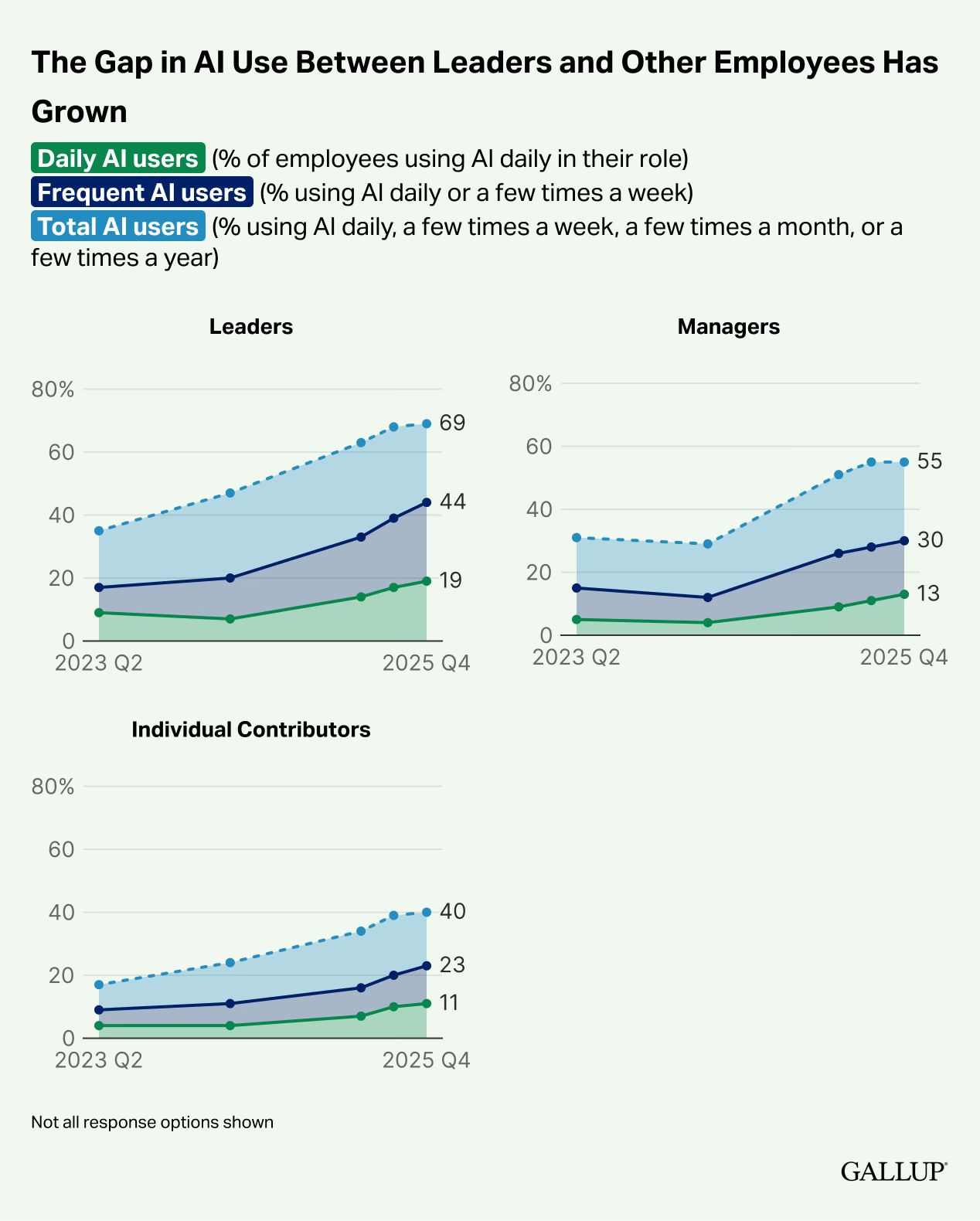
If you’re looking for a correlating factor here, let me suggest that it is bullshit. Who deals in the most bullshit? Why, Leaders, of course. Avidly followed by Managers, who are almost as fluent. Whilst the poor sods on the front line trying to get stuff done, they have little time for it.
I have pondering for a long time how to make the point that AI is going to be a force multiplier for stupidity. I think we can safely say that bullshit is a marker for stupidity, and so now I have some evidence.
AI may be an amplifier for good or bad as was observed above, but when it comes to stupidity, it’s going to be like putting rocket boosters on it.
Mark my words. There’ll be enough stupidity to stretch to Mars.
More Than This
Talking of which, there’s been quite a lot of online chatter about an interview with a co-founder of an AI startup, in which he said the following:
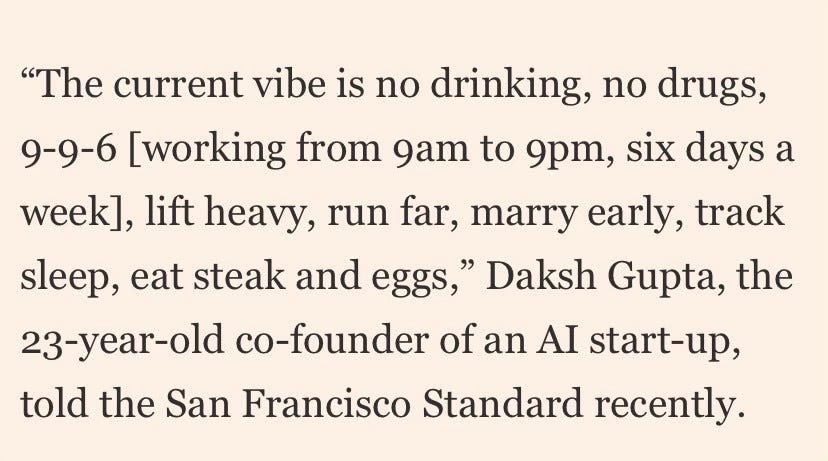
For goodness sake, what is wrong with these people?
The most striking bit is ‘marry early’. I mean, what catch, eh? They won’t be there most of the time because they’re working or ‘lifting heavy’, and when they are around they must be an olfactorial delight on that diet. So much to offer.
The man obviously lives in fantasy land. No, not because of the ‘marry early’ thing, but because he’s obviously blagging furiously and spinning nonsense to get investors to pony up for his start-up, whipping them into a frenzy with his stories of AI taking over the world and making us all redundant.
Ooh, maybe his AI company finds the perfect life partner for you and handles all the messy stuff like the proposal, the prenup and the wedding arrangements, so you just have to turn up and say ‘I Do’. Then you get down the gym and lift heavy, so the whole day’s not wasted.
This above extract is from the Financial Times article, entitled ‘Grindcore is the new hustle culture’, which would explain why it’s so execrable. However, Grindcore is not a new term but is an extreme music genre pioneered in, of all place, the West Midlands of the UK. That proponents of this heavy metal/punk fusion go by names like Napalm Death, Brutal Truth and Agoraphobic Nosebleed probably tells you all you need to know about it.
I was going to say that the FT have made a boo-boo here by mixing the two things up but, on reflection, it seems rather appropriate. The only real point of difference is that the music genre has a degree of humour (black, admittedly) that is starkly absent from the Silicon Valley version.
What a time to be alive, eh?
The Other Side
On my other substack, Surviving Corporate, my latest post is about the ‘Working Wounded’, a phrase that resonated with my own experience of corporate life. Are you ready to acknowledge your wounds and start to work on healing? It took me an inordinate amount of time to get to that point.
I want to help people shorten that process and lessen the harms and damage that you can experience in corporate life, which is why I write about my experience. I also want to facilitate some discussion about these topics, to share and validate experiences, find community and explore some personal actions we can take. If you’d be interested in taking part, you can sign up to the waitlist here.
Always enjoy reading your posts and with a wry smile I will say that the musical genre of grindcore is nothing like these hustle weirdos. Grindcore is exemplified by having a 30 minute set of 20 songs and then you're done and can chill out the rest of the night. The epitome of outputs over clock watching presenteeism :)
Thanks Kathleen. I don't know if an HR-AI has been created but I'm sure someone somewhere is working on one. My guess is it will be quite draconian, whether by design or accident. It really can't end well, can it?